

Quick facts
- Bed bugs bite people and feed on blood.
- They hide and can be challenging to see.
- They are great hitchhikers and can easily be moved by travelers.
- If you have bed bugs, don’t panic, they can be eliminated.
- It is very difficult to eliminate bed bugs yourself. It is best to contact a pest control service to control bed bugs.
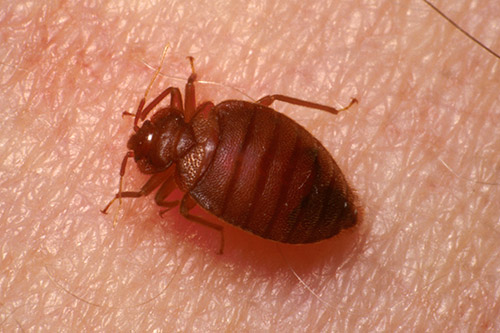
Bed bugs (Cimex lectularius) are parasites that feed on humans, using their blood to grow and reproduce. Bed bugs also feed on animals, including dogs, cats and other pets.
People can be bitten without realizing it. Bite reactions vary from no reaction to mild (a red spot) to severe (rash or hives).
- Reactions caused by feeding might be mistaken for other problems such as biting insects, like fleas or mosquitoes, sensitization to detergents and soaps, and irritants (e.g. poison ivy).
- It is not possible to verify bed bugs from only red skin lesions; finding bed bugs is the only way to confirm they are present.
- Bed bugs are not known to transmit disease to people.
Bed bugs are found in many places, including homes, schools, retail facilities, office buildings, libraries and other public areas.
Bed bugs were almost completely removed from North America due to mass treatments with highly toxic insecticides that are no longer in use. Frequent travel, being good hitchhikers, improved treatment methods that target other insects without affecting bed bugs, and a lack of public awareness has led to a rise in the spread of bed bugs.
Identifying bed bugs


Be sure you have bed bugs before trying to control them. Research at the University of Minnesota found that 76 percent of samples submitted for identification are not bed bugs.
- Adult bed bugs are oval, flattened, brown and wingless insects approximately 1/4 to 3/8 inch long (5-9 mm). They are similar in appearance to a wood tick.
- After the bug has taken a blood meal its color changes from brown to purplish-red and becomes larger and more cigar-shaped.
- Young bed bugs resemble adults in shape but are much smaller, 1/16 inch (1.6 mm) when they first hatch. They are nearly colorless except after feeding.
Contact an expert to help identify any suspected bed bug specimens.
Bat bugs

Another bed bug species that can be found in homes is the bat bug (Cimex adjunctus). They are reasonably common.
- They can bite people but much less frequently.
- Bat bugs look almost identical to bed bugs; they are identified by the longer hairs near the head.
- Bat bugs live in attics and eaves associated with bats, so inspection and control measures must be expanded to include areas where bats may be found.
Other bed bugs
There are other species of bed bugs that may be found in Minnesota but are much less common.
- The chimney swift bug (Cimexopsis nyctalis) and the swallow bug (Oeciacus vicarius) feed primarily on birds.
- They are sometimes found in houses when host birds are nesting in the home (including the attic and eaves).
- These species can also feed on humans if their normal hosts are absent.
- After mating, females lay white, oval eggs (1/16" long) into cracks and crevices.
- An individual bed bug can lay 200 to 250 eggs in her lifetime.
- The eggs hatch in 6 to 10 days.
Newly emerged nymphs seek a blood meal.
- Bed bugs typically bite the head and neck but they will also bite bare arms, hands, and legs.
- They usually live close to where people sleep, rest, or sit for long periods of time.
- They are active at night and generally hide during the day.
- Bed bugs feed for 2 to 5 minutes and then move quickly to a hiding spot.
Bed bugs need to feed at least once before each molt (when they shed their outer exoskeleton), although they could feed as often as once a day.
- Immature nymphs molt five times before reaching adulthood.
- There may be three or more generations per year. All ages are found in a reproducing population.
Under normal circumstances, adult bed bugs will live for about 2 to 4 months.
- Young nymphs can survive without a blood meal for days up to several months.
- Older nymphs and adults can survive longer without a blood meal, up to a year under very favorable conditions.
Signs that you have bed bugs
Look where you sleep
Bed bugs typically group together in out-of-the-way areas, although some bed bugs will live by themselves, away from the rest of an infestation. The best way to check for an infestation is to look for bed bugs where you sleep or rest.
In bedrooms, look particularly on and around:
- Box springs, mattresses, bed frames, tufts, folds and buttons on mattresses.
- Furniture such as desks and chairs.
- Behind wallpaper, clocks and pictures.
- Cracks in wood floors and under the edge of carpet.
While bed bugs are most commonly found in bedrooms, infestations can occur in other rooms including bathrooms, living rooms and laundry rooms.


Look for spots or smears
Bed bugs will sometimes deposit fecal spots (digested blood) while they are feeding. These are seen as dark (dark reddish or brownish) spots or smears found on bed sheets, pillowcases and mattresses, or in nearby areas.
- Dark blood spots on sheets and bedding may indicate bed bug feeding.
- In severe infestations, bed bugs may be more noticeable.
- A combination of bed bugs, cast skins (empty shells of bugs as they grow from one stage to the next) and fecal spots will be very obvious when closely seen.

Inspect carefully
These insects are small and very flat, so they can move into very tight corners and cracks. They have been found under picture frames between the glass and the frame.
Bed bugs can be found behind electrical outlets and other wall plates.
- Inspect all areas closely and, if in doubt, contact a pest control service.
- If you find a bed bug stop inspection and begin control activity.
- Bed bugs will move from their hiding places once disturbed. All further inspections should be accompanied by control measures.
How to avoid bringing bed bugs into your home
Video: How to prevent bed bugs from entering your home (02:17)

The greatest chance of finding bed bugs is while you are traveling. It is a good habit to check your room whenever you stay in a hotel, motel or similar place.
Check your luggage where you typically set it down when you enter your home and where you store it after traveling.
Inspect your personal items before packing and when you unpack
You can only confirm that bed bugs are present by carefully inspecting each item. Pay attention to cracks, crevices, seams and folds of material.
If you find bed bugs, then you have to be careful in containing the infestation.
Bed bugs do not travel on people
Bed bugs may hitch a ride on clothing, but they are not like lice and will not travel directly on a person.
If you are concerned about bed bugs on clothing remove suspect articles and put them into a plastic bag.
- Remove clothing in a place with a non-carpeted floor so bed bugs will have to travel before finding a hiding spot.
- A wet cloth wiped over the floor will help contain any bed bugs that try to escape.
Tips for reducing the risk of bringing home bed bugs
If you think there might be bed bugs on your items seal everything in plastic bags until they can be laundered, washed by hand, heated or frozen.
-
There is no need to throw away luggage and clothing after discovering an infestation.
-
Before leaving the location, sort anything that can be washed and place it in plastic bags.
- Separate the laundry as you would if you were normally laundering items.
- This will prevent escaping bed bugs as you try to sort the laundry at home.
- Set the washer and dryer for the hottest setting that the fabric can stand.
- If using a dry cleaning service, mention that the items may have bed bugs and that they can keep the articles in plastic bags until just before loading them into the machines.
- Inspect suitcases and other items that cannot be placed into a washing machine and place them into plastic bags if you find bed bugs.
- Suitcases may be hand-washed using soapy water and the hottest water possible.
- Test the item to make sure it will not be affected by the hot water.
- A temperature of 100°F to 120°F should be hot enough.
- Use a scrub brush along the seams and folds.
Items that cannot be washed may be heated or frozen.
- A two-hour core exposure at 120°F (45°C) is considered a minimum target temperature for heat treatments.
- For freezing, a minimum of 23°F (-5°C) must be maintained for at least 5 days.
- The exposure time can be reduced if the articles are flash-frozen at a temperature of -15°F (-26°C), which would freeze the eggs instantly.
- Most household freezers will have temperatures between 30°F and 20°F.
- A 2-week freeze time is recommended if you are uncertain of the freezer temperatures.
If you heat or freeze items, these conditions must reach the core of the articles being treated.
Read more about Bed bug free holidays and Inspecting your hotel room for bed bugs.
How to inspect your hotel room for bed bugs (video 03:18)
Used furniture is another potential source of bed bugs.
- Do not pick up beds and furniture that have been left by the curb for disposal or behind places of business.
- Bed bug infestations can be found on tables, drawers and even electronics if these items were located in a bedroom or another place that was infested.
How to get rid of bed bugs
We recommend that you seek assistance from a professional pest control company.
- An exterminator uses specialty equipment to move furniture, take it apart and control the infestation.
- They perform careful inspections along with non-chemical controls (heat treatments, vacuuming and steam treatments) and insecticide treatments.
- The insecticides used are commercial products requiring special equipment and training.
- Pest control services use heat treatment (118°F maintained for at least 70 minutes) in target areas.
- All stages of bed bugs are killed when this is done properly.
- Heat treatment does not prevent bed bugs from coming back into a home and reinfesting it.
- Sometimes furniture is removed and heat treated in a container. But, it is not necessary to move or throw away your furniture or belongings, especially from an apartment or condominium.
It is important to cooperate with a pest control service.
To find a professional belonging to the National Pest Management Association, go to the Pest World website and type in your zip code in the search box under "Find a Professional."
When working with a pest management company there are some additional things you might have to do to help get rid of bed bugs.
Using heat
You can use your washing machine and dryer to kill bed bugs infesting clothes and other washable items.
- Clothes laundered in hot water and/or dried in temperatures hotter than 122°F for 20 minutes will kill all stages of bed bugs.
- This is typically the medium-high setting. If you are not sure what temperature your drier can reach, ask a professional to test it for you.
- You can also heat curtains and other fabrics, rugs, shoes, backpacks, stuffed animals, toys and similar objects by drying them at medium-high for about 30 minutes for a full load.
For more information, see Laundering items to kill bed bugs.
Using cold
Cold temperatures can kill bed bugs if they are exposed to it long enough. All stages of bed bugs will be killed on objects left in a freezer at 0°F for 3 days.
- Putting infested furniture outdoors during winter may kill some bed bugs.
- Outdoor freezing temperatures will not always kill all of the bed bugs infesting an object. But, you can use the cold treatment to disable bed bugs until you decide what to do with the object.
For more information, see how to use freezing conditions to kill bed bugs.
Encasements
An encasement is a fabric covering that looks like a very large sack with a zipper and that completely fits around a mattress or box spring.
They are useful when you want to protect a mattress you know is free of bed bugs (it has been heat treated or you have purchased a new mattress).
- You can also use encasements on infested mattresses and box springs to trap the bed bugs inside them; you can keep using your bed as long as the encasements are not ripped or torn.
- Buy encasements (from professional pest control services) that are specifically designed for protecting against bed bugs.
Bed bug interceptors

Bed bug interceptors are small plastic trays with an inner and outer ring designed to help detect the presence of bed bugs. You place them under the bed legs.
Bed bugs that try to climb up from the floor to the bed become trapped in the outer well. Any bed bugs that try to climb down will become trapped in the center well.
- Bed bug interceptors not only help to reduce the number of bed bugs that can reach the bed but also help determine whether bed bugs are present.
- You can buy bed bug interceptors online, from pest management companies, or from retail stores.
Insecticides
- Do not try to treat bed bugs yourself. The insecticides available in over-the-counter products are not effective in controlling bed bugs.
- Bug bombs (total release foggers) are not effective when treating bed bugs.
- These products throw insecticide into the air and very little product comes in contact with bed bugs hiding in cracks and behind and under objects.
- Bug bombs are potentially flammable if used incorrectly. It is easy for people to misuse or overuse bug bombs, and can result in unnecessary pesticide exposure.
CAUTION: We strongly discourage you from trying to treat bed bugs yourself. But, if you decide to use a pesticide, it is very important to carefully read and understand the label before using and to follow all label directions. The product you use should be labeled for bed bugs.
Reviewed in 2023